Cross-Curricular Word Searches: Using Puzzles in Math, Science, and More
Written by
MyPuzzlePrint TeamCross-Curricular Word Searches: Using Puzzles in Math, Science, and More
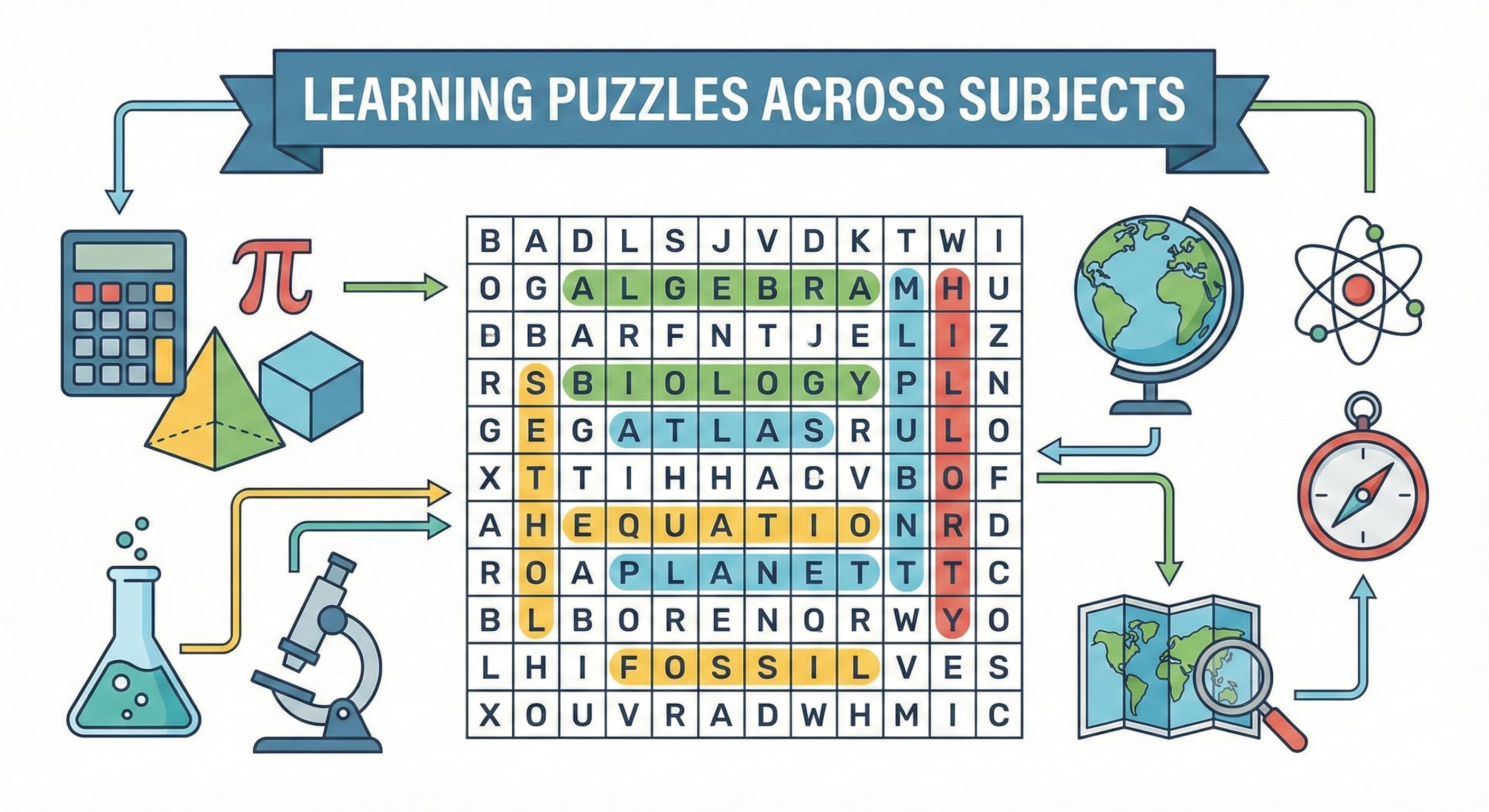
Word search puzzles arent just for language arts - they can be a creative and effective tool to reinforce concepts in any subject. By incorporating relevant terminology into puzzles, we help students familiarize themselves with the vocabulary of math, science, social studies, art, and beyond in an engaging way. This approach makes learning feel more like a game and shows kids the interconnectedness of words and ideas across the curriculum. In this article, well explore how to create and use cross-curricular word searches. Youll find examples and ideas for subject-specific puzzles - from spelling out numbers and shapes for math practice to hiding the names of important historical figures or scientific terms. Whether youre a teacher looking to spice up a unit or a parent trying to enrich your childs learning at home, cross-curricular word searches can be a fun addition to your toolkit.
Math Word Searches: Numbers and Shapes in Words
Mathematics might seem like an odd fit for word searches since it often deals with numbers rather than letters. But theres plenty of language in math! For younger students just learning number words, a word search can help them recognize and practice spelling number names (one, two, three, etc.). You can create a puzzle with numbers 1-10 or 1-20 spelled out and hidden in a grid. Not only do they practice reading those words, but they also make a connection between the symbol 4 and the word four in a playful context. For slightly older kids, consider including shape names or other geometric terms. Words like circle, square, triangle, oval, hexagon could be hidden for a shape unit. As they search for triangle, for instance, you might encourage them to count how many triangles they can find around them in the classroom or home afterward, merging the word recognition with the concept itself.
Math puzzles can also include terms like add, subtract, plus, minus, equal, etc., as a way to familiarize students with those words. If youre dealing with higher grades, integrate vocabulary of mathematical operations or concepts: factor, sum, difference, product, quotient, parallel, perpendicular, etc. While solving the puzzle, students are repeatedly looking at those terms, which can reinforce spelling and meaning (especially if you discuss or define them in class).
One fun twist: include a hidden math problem in the word search. For example, after they find all the number words, the unused letters might spell out a simple equation or answer to a riddle (2+2=4 or Math is fun). This encourages them to complete the whole puzzle and adds an extra layer of engagement. By making math terminology a part of a word game, we help demystify the sometimes intimidating jargon of math class and show that its just another language - one they can master.
Science Word Searches: From Planets to Body Parts
Science is rich with terminology that can sometimes overwhelm students. Turning those terms into a word search can transform memorization into an interactive challenge. Take astronomy for instance: a word search of the planets (Mercury, Venus, Earth, etc.) or constellations can supplement a space unit. As kids hunt for Jupiter, they inevitably discuss with friends or recall, Oh, Jupiter is the largest planet, thereby reinforcing knowledge through association. Similarly, a puzzle on the human body could include names of major organs or bones (heart, lungs, femur, rib, skull). Its a great way for students to practice spelling tricky words like intestine or cerebrum.
Life science topics are perfect too - consider a puzzle with animal classifications (mammal, reptile, amphibian, etc.), or one with different habitats (rainforest, desert, ocean, tundra). Earth science could have terms like volcano, earthquake, erosion, fossil. By searching for these words, students become more familiar with them and more confident using them. Plus, it opens up opportunities for questions: a child might ask, What is erosion? when they see it on the list, leading to a teachable moment either at home or in class.
For a chemistry flavor at higher levels, you could hide element names or important molecules (though you might limit directions to horizontal to help find long words like photosynthesis). Speaking of photosynthesis, an advanced puzzle for biology class might include parts of a plant or processes (photosynthesis, pollination, germination) which can spark recall of how to spell those big words and what they mean.
Science word searches can also be timed with events - for example, around Earth Day, a puzzle of eco-friendly terms (recycle, conserve, biodiversity) or during a health week, a puzzle of healthy habits (exercise, nutrition, sleep, water). These tie in current discussions to a playful activity.
To maximize learning, encourage students to use each found word in a sentence or explain it after they complete the puzzle. They might say, I found evaporation. Thats when water turns into vapor. This way, the word search is just the starting point of a science conversation. By integrating key vocabulary into a puzzle, we help students become comfortable with the language of science - an important step in mastering the concepts themselves.
Social Studies and Geography Word Searches
Social studies is another area where word searches can be incredibly useful. Think about all the geography terms and place names students encounter - these are perfect for puzzles. For example, when learning the states or countries, a word search can reinforce their names . You might create a puzzle with all the continents, or one with a selection of country names. Students often love finding places they know (I found India! Thats where my grandparents are from) - it creates a personal connection. Puzzles can also include capitals (hiding Paris, Tokyo, Nairobi in a grid of letters) which familiarizes students with spelling and recognizing these cities.
In history class, use word searches to familiarize students with names of historical figures or important events. For instance, a puzzle on the American Revolution might include Washington, Jefferson, Liberty, Boston, Redcoat, etc. As they search for Jefferson, they are also mentally reinforcing that name and perhaps recalling, Oh, Jefferson wrote the Declaration of Independence. Its light review in disguise. Similarly, if studying ancient Egypt, a puzzle could hide pyramid, pharaoh, Nile, mummy, etc., making those thematic words more present in students minds.
Government and civics terms (constitution, democracy, election) can also be put into a word search to help drill those into memory. This can be particularly helpful right before a quiz - instead of rote memorization, a quick puzzle gets them to focus on each term one more time.
For cultures and languages, word searches can be both educational and a celebration of diversity. You could incorporate simple words from different languages (like numbers or greetings in Spanish, French, Chinese, etc.) into a puzzle as part of a social studies exploration of world cultures - a subtle way to show connections and spark curiosity (I found hola - thats hello in Spanish!).
One engaging activity is to use a map word search. This is where, for instance, you overlay a word search grid on a simplified map and have the names of regions or rivers hidden where they actually are located. Its a bit more complex to create, but very rewarding - students search not only through letters but also through the geography itself, finding that Amazon is hidden running along where the Amazon River would be. This might be more for a teacher or homeschooling parent with time to customize, but its a memorable learning experience.
As always, follow up on social studies puzzles with discussion: Which words did you find? Can someone tell us who or what that is? This ensures the puzzle reinforces actual understanding. By doing cross-curricular word searches in social studies and geography, we help students cement factual knowledge (like place names and historical terms) in an enjoyable way, reducing the intimidation factor of big unfamiliar words.
Arts, Music, and More
Cross-curricular puzzles arent limited to the core subjects; they can enrich learning in the arts and other special areas too. In art class, imagine a word search that includes names of primary colors, famous artists (like DaVinci, VanGogh, Frida), or art techniques (collage, sculpture, perspective). As students look for Monet in the puzzle, it could prompt a conversation about Monets style of painting. This method sneaks a bit of art history or theory into a fun format, which can complement hands-on art projects by building their art vocabulary.
For music, a puzzle might hide terms like tempo, melody, scale, piano, forte, and so on, or even names of composers (Bach, Mozart, Beethoven). Choir or band teachers might love a puzzle with musical symbols and Italian terms used in music (like allegro, fortissimo, staccato) - although those can have unique characters, just spelling the words out is beneficial. It gives students an extra exposure to those terms beyond just seeing them on sheet music.
If children are learning a foreign language, word searches can be a great tool for practice. For example, a Spanish teacher might create a puzzle with Spanish color words or animal names, which the students find and then perhaps translate as an additional step. This reinforces vocabulary through repetition and recognition. (And on the flip side, for ESL students, a word search of common English sight words or thematic vocabulary can be a gentle way to practice spelling them).
Even subjects like physical education or health could use word searches - think of a puzzle of exercise names, sports, or healthy habits as mentioned earlier. For example, a health class puzzle might include hydrate, vegetables, stretching, sleep, which could lead to a quick discussion on each healthy habit once theyre all found.
The key across all these areas is that word searches serve as a springboard for engagement. They often pique students curiosity (What does this word mean?) or at least repeat exposure to important terms. And because its a game-like format, students are usually more willing to dive in. The arts and other subjects benefit from this because it shows that even here, where creativity reigns, theres valuable vocabulary to know.
One more cross-curricular angle: interdisciplinary puzzles. You can mix subjects in one puzzle for a special themed day or review session. For example, at the end of the year, a Mega Review word search might include key terms from math, science, history, and literature all jumbled together. Its a fun way to see how much they recall, and it illustrates that learning isnt segmented - it all intersects in the real world (and now in their puzzle!). Students might find Magna Carta right next to mitosis, or Shakespeare running under Pythagoras. It can be a great culminating activity that sparks reflection on everything theyve learned.
Conclusion
Cross-curricular word searches demonstrate that puzzles arent just a diversion; theyre a versatile educational ally. By thoughtfully selecting terms from math, science, social studies, the arts, and beyond, we can reinforce subject matter in a way that feels like play. Students get to strengthen spelling and recognition of important terms, make connections between words and concepts, and have fun in the process. These puzzles can be easily customized to whatever topic is at hand, making them a handy addition to any lesson plan or home learning session. So whether youre helping a child master the names of the planets or the capitals of Europe, consider creating a word search. It just might turn studying into an exciting challenge. With puzzles, learning spans the whole curriculum - one word at a time, hidden in a sea of letters, waiting to be discovered. Happy word hunting across all subjects!