Integrating Word Search Puzzles into Classroom Learning
Written by
MyPuzzlePrint TeamIntegrating Word Search Puzzles into Classroom Learning
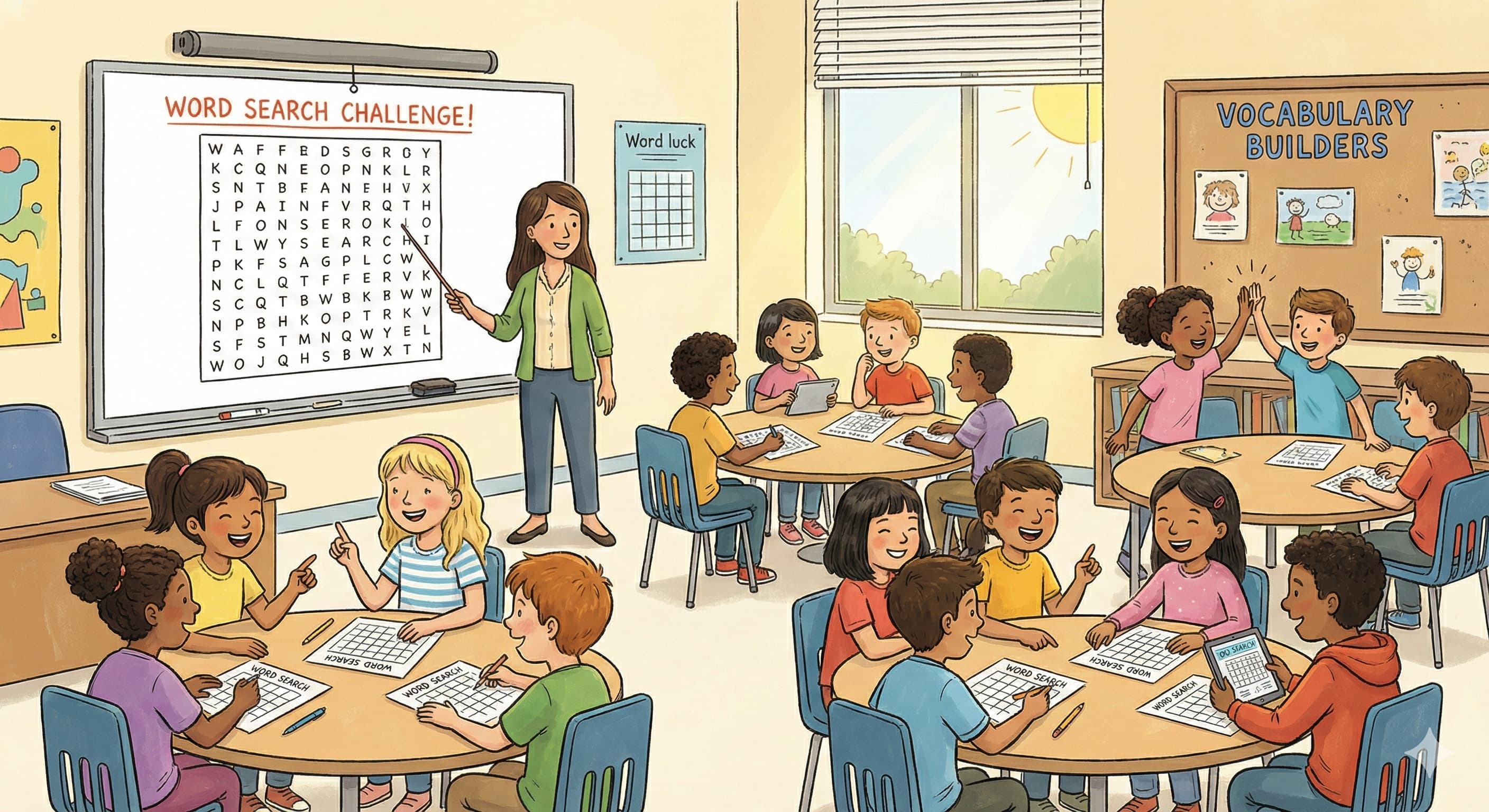
Word search puzzles arent just for rainy day free time - they can be a valuable addition to classroom learning when used thoughtfully. Teachers around the world have found creative ways to incorporate word searches into lessons to reinforce key concepts, introduce new vocabulary, or simply add a dose of fun to the curriculum. In this section, well explore strategies for using word search puzzles in educational settings. Whether youre a teacher or a homeschooling parent, youll learn how to align puzzles with your learning objectives, keep students engaged, and avoid the busywork trap. Word searches can be much more than a time-filler; they can actively support and enhance your teaching. Lets see how.
Reinforcing Lesson Vocabulary
One of the best uses of word searches in the classroom is to reinforce vocabulary from your current lessons. After introducing a set of new terms - say in a science unit on weather or a social studies unit on geography - give students a word search containing those terms. This turns review into a game. As students search for each word, theyre recalling its spelling and meaning. For example, in a lesson about the water cycle, a word search might include words like evaporation, precipitation, and condensation. Finding these words helps commit them to memory. Its a subtle form of repetition; the more times students see and engage with a term, the more it sticks. Teachers can either find pre-made puzzles on the topic or use one of the many free word search generators online to create a custom puzzle with their lessons vocabulary list. Because these puzzles cover a wide range of topics across the curriculum, you can likely find a puzzle (or easily make one) for virtually any subject - from math terms to historical figures. Importantly, make it educational by following up: once the word search is complete, discuss the words. Ask students to use one of the found words in a sentence or explain it to a peer. This ensures the puzzle wasnt just a passive activity; it actively reinforced the lesson content. Many teachers find that students remember new terms better after doing a related word search, because theyve seen the word in a different context (the puzzle) and had a bit of fun with it.
Icebreakers, Bell-Ringers, and Brain Breaks
Word searches can also smoothly fit into the daily rhythm of a class as icebreakers, bell-ringer activities, or brain breaks. At the start of class (bell-ringer), a quick themed word search on the days topic can settle students in and get them thinking about the subject matter. For instance, if todays geography lesson is about Asia, a five-minute Find the Countries of Asia word search as students enter the room can activate prior knowledge and generate excitement. It primes their brains for whats coming. As an icebreaker at the beginning of the year or a new unit, puzzles can encourage interaction. You can have students work in pairs or small groups to solve a larger word search, which helps them practice teamwork and communication in a low-stress setting. (Some teachers even make giant poster word searches that the whole class works on together with markers - a great teamwork exercise!). For brain breaks, when kids have been sitting through a heavy lesson and need a mental reset, a short word search shifts gears while still keeping their minds engaged. It offers relaxation because its enjoyable and different, but its not completely off-task - they might be searching for science terms or vocabulary from earlier, so learning is still happening. Students often find this a refreshing breather that still feels productive. And because puzzles are quiet work, they give a teacher a chance to handle attendance, set up a lab, or assist individual students while the rest of the class is busy. In all these cases, the key is to align the puzzle content with either the subject at hand or general language skills, so its not just random - it has a purpose in your lesson flow.
Differentiation and Support
Another advantage of word searches in the classroom is how easily they can be differentiated to suit different learners. For students who are earlier in their reading journey or those who struggle, you can provide simpler puzzles (maybe smaller grids or with words only horizontal/vertical). For instance, younger students might get a word search with basic sight words or picture clues (a small image of a cat next to the word cat in the list). More advanced students, on the other hand, can be given larger puzzles or ones with diagonal and backward words to increase the challenge. You can even have extra mystery words in a puzzle that arent listed, and see if they can find words related to the theme that werent given - a little bonus challenge. In a single classroom, you might quietly hand out two versions of a puzzle: one with, say, a 10x10 grid and straightforward words for learners who need support, and another with a 15x15 grid and trickier placements for those who need enrichment. Since the puzzles look similar and cover the same topic, no one feels left out or labeled. Word searches are also great for English language learners (ESL) or students with reading difficulties. They provide a different mode of interaction with words - very visual and kinesthetic (circling) - which can be less intimidating than blocks of text. These students often benefit from the letter-by-letter focus of a puzzle. They might not yet be fluent in reading sentences, but finding tiger in a jumble of letters is a rewarding way to practice those letters and the word. Its also something they can do at their own pace, building confidence. Teachers have found that word searches can be particularly useful right before a spelling test or vocabulary quiz as a last review. One teacher shares that she gives a quick word search with the weeks spelling words on Friday morning; students think its a treat, but she knows theyre essentially writing each word in their mind one more time before the test. And sure enough, it helps with recall. Overall, integrating word searches allows you to cater to multiple learning styles - visual learners love seeing the word patterns, kinesthetic learners enjoy the act of circling, and all learners benefit from the novelty and fun factor.
Making It Meaningful
One critique of word searches is that they can be busywork if not used meaningfully. To avoid this, its important to tie puzzles to clear objectives and follow up with discussion or extension activities. For example, after a literature unit, instead of a generic puzzle, use a word search of characters names or new words from the book - then have a conversation about those names/words once the puzzle is done (Which characters name was hardest to find? Who can tell us one thing about them?). As mentioned earlier, discussing the words and concepts afterward reinforces that the puzzle was educational. Another strategy is to incorporate a second layer of learning into the puzzle. Perhaps the unused letters in the grid spell a secret message related to the lesson, which students can discover once theyve found all the listed words. This encourages them to fully complete the puzzle and then do a bit of extra decoding. For instance, after a history lesson on presidents, a word search might have a hidden message like HONESTY or NEW DEAL formed by leftover letters - a springboard to a quick review discussion. Teachers can also combine word searches with other assignments: Finish the word search, then pick two of the found words and write a definition or a short story using them. In this way, the word search isnt the end, but the means to another educational end. By connecting puzzles with lesson content and follow-up activities, you ensure they are a rigorous learning tool, not just a time-killer. And when used this way, students tend to be highly engaged. They appreciate the break from routine while still recognizing the relevance to what theyre learning. In fact, word searches can inject a bit of joy and lighthearted challenge into subjects that might otherwise feel dry. They show that learning can have an element of play, which often leads to higher overall student motivation.
Conclusion
Integrating word search puzzles into classroom learning can be a win-win strategy. Students get to enjoy a game-like activity, and teachers get another method to reinforce content and skills. By aligning puzzles with your curriculum - whether its reinforcing vocabulary, providing differentiated practice, or energizing your class with a fun challenge - you turn a simple puzzle into a powerful educational ally. The key is thoughtful usage: choose (or create) puzzles with purposeful word lists, and debrief or extend the activity so that the learning is explicit. Done right, word searches can enhance lessons in science, math, language arts, social studies, and more. They engage students, support different learners, and prove that sometimes, the simplest educational tools are still among the best. So next time you want to spice up a lesson or give your students a new way to interact with words, consider adding a word search into the mix - and watch your classroom light up with focused, enthusiastic learning.