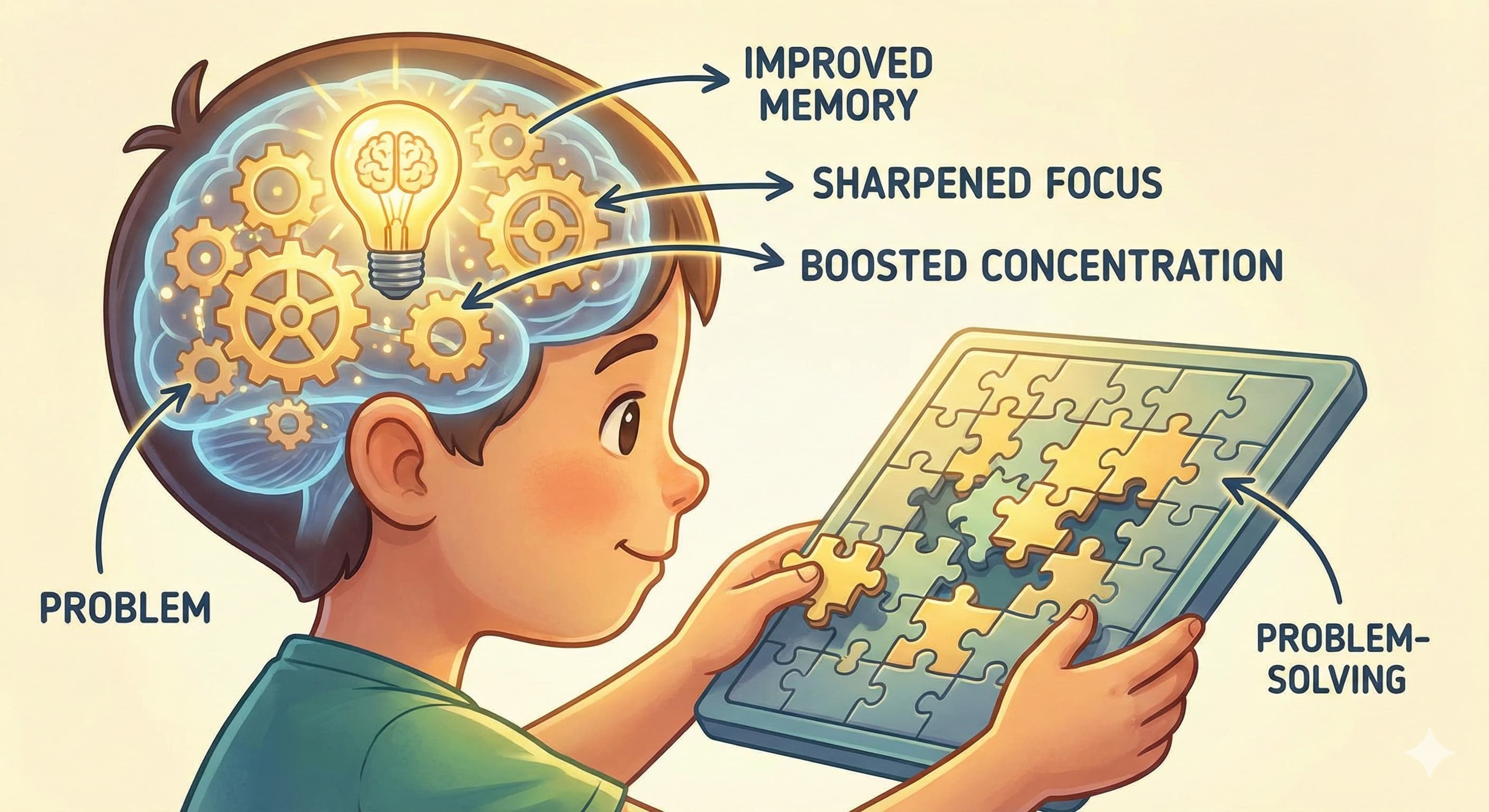
Sharpening Memory and Concentration with Word Search Puzzles
Written by
MyPuzzlePrint TeamSharpening Memory and Concentration with Word Search Puzzles
In an age of constant distractions, helping children develop strong memory and concentration skills is more important than ever. Interestingly, one simple activity that can aid in this development is the word search puzzle. Many parents have noticed how a usually fidgety child can become absorbed when working on a word search. That deep focus isnt just a momentary peace and quiet - its exercise for the brain. In this section, well look at how word search puzzles can improve kids memory (especially working memory) and concentration. Well explain whats happening in those little minds as they hunt for hidden words and why that can translate into better attention spans and memory recall in everyday tasks.
Training the Working Memory
Working memory is the ability to hold information in your mind while you use it - like remembering a phone number long enough to dial it, or keeping a question in mind while reading a text for the answer. Word searches give a childs working memory a workout. When kids search for a word, they must recall the words spelling (or at least its first letter or two) at the same time as they scan the grid. For example, if the word is boat, a child might think B-O-A-T, boat repeatedly in their head while looking for those letters. This task of remembering a sequence of letters while performing a search operation exercises the memory in a focused way. Educators note that puzzles like crosswords and word searches, where vocabulary and definitions are accessed from memory, can help improve working memory. Each time your child finds a word, its essentially a success for their working memory: they kept the target in mind and successfully applied it to the puzzle. Over time, practicing this process can enhance their ability to juggle information mentally. You might notice benefits beyond puzzles, too - perhaps your child becomes better at following multi-step instructions or remembering details from a story you read together. Thats their trained working memory at work!
Building Longer Attention Spans
Concentration is like a muscle - the more you use it, the stronger it gets. Word searches are particularly good at capturing childrens attention for extended periods. Unlike many fast-paced video games or TV shows, a word search doesnt have constant flashy changes; it requires sustained attention on a static page. This makes the brain practice staying on task. When starting out, some kids might only stick with a puzzle for a few minutes before getting antsy. But with encouragement, they often progress to focusing longer as they get drawn into the challenge. Completing a word search from start to finish might take, say, 10 or 15 minutes of continuous concentration for a child - which is excellent practice. This focus on the puzzle can translate into better focus in other contexts, like listening to a teacher or doing homework, because the child has experience tuning out distractions to meet a goal. There is also a positive feedback loop at play: as children find words, they feel a sense of accomplishment which rewards their concentration and motivates them to continue. Essentially, their brain learns that focusing pays off. According to cognitive research, puzzles help improve focus and energy levels by producing feel-good hormones (when you solve something tricky, your brain gives you a little hurrah of dopamine). Those little bursts of satisfaction can help train kids to stay engaged longer. Parents and teachers often observe that even kids who struggle with attention in other areas can become remarkably absorbed when working on a puzzle they enjoy - showing that sometimes its about finding the right activity to unlock their focus.
Improving Short-Term and Visual Memory
Working on word searches can also boost short-term memory and visual memory. Short-term memory (closely tied to working memory) is what lets you hold small bits of info in your mind (like recalling what word youre searching for or which letters youve already checked). In a word search, children frequently refer to the word list, then look at the grid, then back to the list. Each time they look away from the list, they challenge their short-term memory to hold the words spelling. The more they practice this loop, the better they get at briefly storing and recalling information - a skill thats helpful for things like remembering a question while reading a text or recalling instructions given moments ago. Visual memory comes into play once a child has seen a word in the grid. Sometimes they might spot part of a word (say APP in APPLE), look away, and then have to remember where that was. Or after scanning the puzzle, they keep a mental image of where certain letters (like all the Bs) are located. These actions practice storing and retrieving visual information. Its similar to how, when reading, children eventually form a mental image of words that helps them recognize those words instantly later. In fact, the focus required to complete a word search without forgetting what youre looking for has been likened to a memory exercise recommended even for older adults. For kids, its like a fun gym session for the brains memory centers. Over time, kids who do puzzles often may find they can recall things more readily - whether its the sight words they learned last week or where they left their library book!
Low-Tech, High-Benefit Focus Practice
One great thing about word searches is that they are screen-free and simple, which actually aids in concentration and memory training. Without the multi-sensory overload of digital devices, children focus on just the letters and the task. The act of physically circling a word with a pencil can also help commit that find to memory (a bit of muscle memory reinforcement). Puzzles are quiet and slow-paced, allowing kids to concentrate deeply without external stimulation. This can be especially beneficial if a child tends to be easily distracted - the puzzle itself becomes a calm, focused environment for their mind. Parents have reported that incorporating a daily word search (even just one puzzle a day) resulted in noticeable improvements in their childs ability to sit and focus on other tasks like reading or homework. Its as if the puzzles tune the childs focus engine each day. Additionally, because puzzles are enjoyable, children are willing to concentrate on them, which gives genuine practice in an organic way. Over time, they might naturally lengthen their attention span - first they could only do 5 minutes, then 10, then 20 as they get into harder puzzles or become determined to find that last word. This increased patience and concentration can spill over into the classroom or other learning settings.
Conclusion
Word search puzzles demonstrate that sometimes the simplest activities can yield significant cognitive benefits. By searching for hidden words, children exercise their working memory, strengthen their short-term recall, and practice concentrating on a task without interruption. Its a form of mental discipline wrapped in a game. So if youre looking for a way to help an antsy child practice focusing, or want to give their memory a fun challenge, consider making word searches a regular part of their routine. These puzzles are proof that screen-free brain games can be both engaging and beneficial. As kids sharpen their memory and concentration with each circled word, theyre building habits and mental skills that will benefit them across all areas of learning and life.